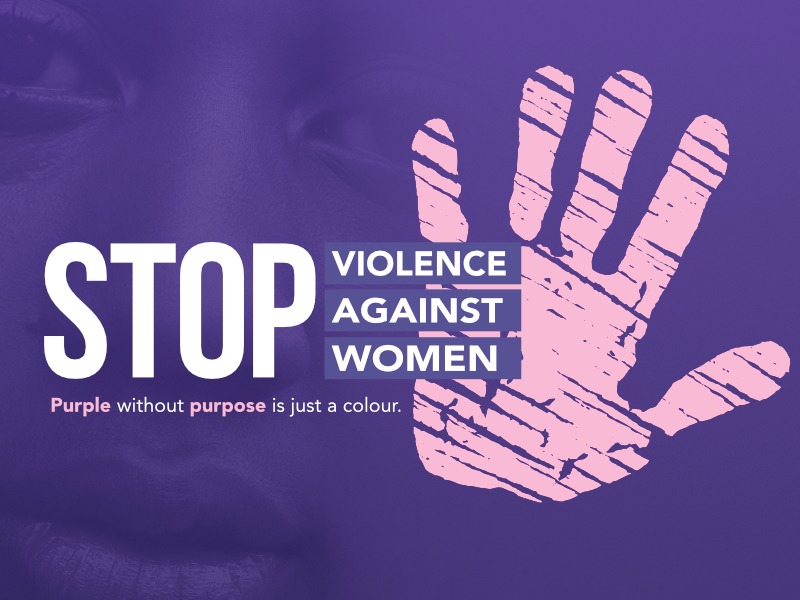
This week, South Africa is turning purple, not for fashion, not for flair, but for fury. The Women for Change Purple Movement has sparked a national moment of reckoning. Across social media and city streets, South Africans are colouring the country purple to demand action against gender-based violence and femicide (GBVF). We should all be paying attention because this isn’t just about a campaign, it’s about who we are and what kind of country we are becoming.
The movement has a simple ask: a collective standstill to say, “We cannot keep lifting a nation that continues to crush the very people who give it life.” Every purple post, space, piece of clothing and ribbon carries the same message: we are tired. And we are demanding more than awareness because we want change that counts.
The statistics: Let’s talk about what those numbers really mean.
We hear statistics so often that they’ve become white noise. But let’s sit with them for a second. South Africa’s femicide rate is six times higher than the global average. Imagine a classroom of thirty women from around the world. If violence claims one life elsewhere, it claims six here. Six futures erased. Six families shattered. And yet, we scroll on. We read, we sigh, and we move to the next story. Our desensitised minds have normalised it to the point that it barely registers.
That’s why this purple movement matters. It’s forcing us to look again, not out of pity, but out of accountability.
At Zip Zap, we see the other side of those headlines.
We work with some young people who have grown up in environments where fear is normal, where opportunity is rare, and where hope can feel like an unaffordable luxury.
In our programmes, these young people learn something radically different. They know what it feels like to trust someone enough to let go. And I mean literally let go. They understand that strength doesn’t mean dominance; it means discipline. That courage doesn’t mean recklessness; it means showing up. That is how you build a different kind of world with hope, one child, one act of trust at a time.
When you watch a Zip Zap student soar on a trapeze or balance on another’s shoulders, you are not watching a circus. You are watching a transformation. Because the moment that child realises, I am capable, I am safe, I am worthy, something fundamental shifts.
And that shift is our quiet revolution. This is what stands between a life of fear and a life of freedom. Every day, we work with children and young people who grow up surrounded by violence, sometimes in their homes, often in their communities. Violence begins long before the act itself. It starts when a child grows up without confidence, without hope, without a sense of belonging. Zip Zap interrupts that.
When a young girl joins Zip Zap, she doesn’t just learn how to juggle or balance on a trapeze. She learns to trust her body, believe her worth, and find her voice. When a young boy learns to catch his partner mid-air, he learns respect, responsibility, and equality, not as theory, but as muscle memory.
We create the space where equality isn’t just taught, but lived.
Purple without purpose is just a colour.
Lighting up a city in purple is powerful. But unless that colour stains our conscience and our policies, it will fade like all colours do. If we genuinely want to change the story, we must start earlier, long before a woman is harmed, before a boy learns that power equals control.
We need spaces that rewire the script and where equality isn’t a slogan; it’s the way we work, train, and live together.
Prevention doesn’t make headlines, but it changes them.
Our call is simple
Turn purple, yes, but don’t stop there. Support organisations that are doing the long, patient work of support, prevention and transformation. Hold leaders (including me) accountable for how we use our influence, our resources, our voices, because a purple South Africa means nothing if our homes and streets stay red with violence.
At Zip Zap, we’ll keep doing what we’ve been doing for over 30 years: using art to teach empathy, collaboration, and hope. Because when you give young people those tools, you’re not just changing their story, you’re changing a nation’s story. A safer country isn’t about colour. It is about courage, action and change.